Your Weapon is Your Voice: Overcoming Fear by Speaking God’s Word
Here is something that doesn’t get enough attention in most conversations about overcoming fear: the most influential voice shaping your inner world is your own.
Not the voice of someone who loves you. Not the voice of the most gifted speaker you’ve ever heard. Not even the voice of someone who has spoken powerfully over your life. Your voice. The words that come out of your own mouth carry a level of authority over your inner life that almost nothing else matches—which means your mouth is either your weapon or the enemy’s open channel into your own head.
This is not mysticism. It’s the way human beings are wired. When you hear yourself say something—especially something you say repeatedly—you believe it at a different level than when you merely think it. The mouth leads the mind more than most people realize. Which means the words coming out of your mouth every day are not just reflecting your inner life—they are actively determining who wins the war for it.
Fear entered the human story through spoken agreement. A suggestion was made, it was heard, it was believed—and then it was spoken. Once spoken, it spread. It moved from one person to another and eventually took an entire community hostage for decades.
Faith works the same way in reverse. It begins internally, but it is deployed—activated, strengthened, armed—through what is said out loud. A person can believe something privately and have it stay at the level of quiet conviction, not moving much of anything in their daily experience. But when they begin to speak it—especially when they speak it in situations where they don’t feel it, where the evidence seems to argue against it—something starts to break loose.
This is why the consistent instruction across Scripture is to say it. Not just believe it. Not just think it. Not just hold it as a private conviction. Say it, out loud, like it’s already won.
Let the weak say: I am strong. I will say of the Lord: He is my refuge and fortress. Hold fast to the confession of your faith.
The pattern is too consistent to be accidental. Faith has a sound. And that sound—your voice, firing God’s truth even when you don’t feel it yet—is one of the most powerful weapons available to you.
You are not telling yourself that everything is fine when it isn’t. You are not performing positivity or pretending the problem doesn’t exist. You are asserting a reality that is more ultimately true than your current experience is telling you, and asserting it with enough force to overwrite what fear has been broadcasting.
When a man whose finances are in ruins says, God is my Provider, and I trust that provision is coming, he is not lying. He is refusing to let fear’s prediction be the loudest voice in the room. He is choosing to speak from the foundation rather than from the feeling. That is not dishonesty—it’s an act of war fought with words.
Here’s the practical challenge this chapter presents: spend a week actually listening to what you say. About your situation. About your future. About your own capacity. About God’s willingness and ability to show up. You may be shocked at how much ammunition you’ve been handing the enemy, and you may begin to understand why the anxiety keeps regrouping and returning.
Then start changing what you say. Not with dramatic proclamations—just with the steady, daily practice of choosing different words. Replace I’m overwhelmed with this is hard, and I have what I need to get through it. Replace nothing ever works out for me with I’ve made it through every hard thing so far. Replace I don’t know how we’re going to make it with I don’t have the full picture yet, and the One who does is not panicking.
Small shifts, practiced daily, add up to something significant—and over time, decisive.
There’s a reason the Bible describes death and life as being in the power of the tongue. That is not poetic language. It’s a description of how the spiritual world actually operates. What you speak enlists you on one side or the other—the side fear is recruiting for, or the side where God has already secured your victory.
Choose carefully. Speak like a weapon. And watch your inner world start falling in line with what your mouth has been declaring.
Standing When the World Shakes
We are living in a time that has no shortage of things to be afraid of.
Political instability and deep cultural confusion. Economic pressure that touches more families every year. A steady erosion of things that previous generations simply assumed would always be there. A sense, felt widely across many communities of faith, that the world their children are inheriting is fundamentally different, and not in ways they’d have chosen, from the world they grew up in.
This chapter is not going to minimize any of that. Pretending things are fine when they aren’t isn’t peace—it’s avoidance. And people who are paying attention don’t need to be told everything is okay. They need to know what to do with the fact that it isn’t.
Here’s what needs to be said plainly: the world has always had its earthquakes. Every generation has faced a moment—some have faced many—when the ground moved under their feet. When the institutions they trusted failed them. When the future they had planned became unavailable. When the certainties they relied on dissolved overnight.
What separated the people who held the line from the people who collapsed was never the absence of shaking. It was what they were anchored to before the shaking started, and what they refused to abandon while it was happening.
Buildings that survive earthquakes are not necessarily the biggest or the most expensive. They’re the ones built with the right foundation and the right structure—engineered to take the hit without giving ground. Buildings that look solid from the outside but have no proper foundation are the ones that collapse. Not because the earthquake was stronger for them, but because what they were built on couldn’t hold the line.
The same is completely true for a human life. A life built on the assumption of comfortable circumstances, political stability, financial security, and cultural agreement will eventually encounter a season when all of those things are simultaneously under attack. And that season will expose exactly what’s underneath.
A life built on something that doesn’t shake can absorb what life throws at it. Not without difficulty. Not without pain. Not without moments of genuine uncertainty. But without being broken by any of it.
Here is the practical question this chapter is asking you: What does it look like to hold your ground right now—in this specific moment, in this specific cultural and personal season—from a place of genuine peace rather than managed anxiety?
Notice the question isn’t asking you to feel nothing. It isn’t asking you to pretend you’re not affected. It isn’t asking you to stop caring about what’s happening in the world around you. It’s asking you to find the fortified position—the still center in the middle of the storm—and operate from there rather than from the chaos on the periphery.
People who find that place become a qualitatively different kind of presence in the spaces they occupy. They can think clearly when others are panicking. They can make good decisions when everyone else is reacting. They can show up in their families, their communities, their workplaces as sources of stability rather than as people barely holding their own line.
The world around you needs that kind of person right now. Not perfect people. Not people who have all the answers. People who have found ground that holds—and who stand on it so visibly that others start to wonder if it might be available to them too.
This is one of the most important things you could ever become. It starts inside. But it never stays there.
There is also a practical, outward-facing dimension to this that can’t be skipped. Living free doesn’t mean retreating into a quiet inner world while everything around you burns. It means bringing what you’ve secured inside into the spaces around you. It means showing up at the school board meeting when your kids need someone to represent their interests. It means starting the conversation with your neighbor that nobody else is willing to have. It means using your circle of influence—however large or small—to carry ground that not enough people are willing to hold right now.
Every generation is given a moment. This is yours. The question isn’t whether the moment matters. It clearly does. The question is who are you going to be in it—someone swept entirely by the winds of the cultural moment, or someone anchored deeply enough to actually push back against the direction things are heading.
Walls that protect cities need watchmen. The watchmen who hold longest are the ones who have made peace with the fact that the wind will blow, the night will be long, and they are staying at their post anyway. Not because it’s comfort-able. Because it matters, and because someone has to hold that ground.
Stand. Hold. Let your steadiness do the talking.
Fear does not get to control the life God made you to live.
What if the fear you have learned to manage was never meant to become part of your identity? What if the anxious thoughts, worst-case scenarios, and constant pressure shaping your decisions are not voices you have to obey? And what if you could live free even when the world around you remains uncertain?
You do not have to deny reality to defeat fear. You have to learn how to recognize the story fear is telling, confront it with truth, and refuse to surrender the ground God has given you.
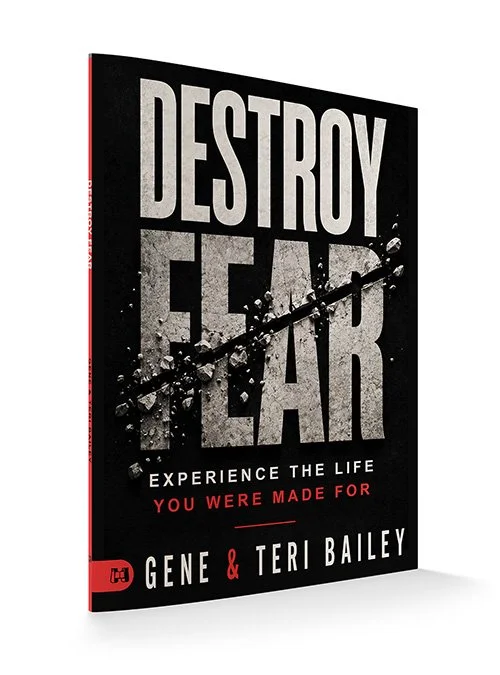
In Destroy Fear, Gene & Teri Bailey reveal a powerful biblical framework for understanding how fear gains influence through distorted thinking, damaged identity, anxious agreement, and disconnection from the love of God. This breakthrough resource moves you beyond merely coping with fear and equips you to confront it at the root.
Through these pages, you’ll discover how to:
Separate fear from your God-given identity and stop accepting anxiety as “just who you are.”
Receive the Father’s love as the force that drives fear from its deepest strongholds.
Stand with courage and clarity when circumstances, culture, and the future feel unstable.
Break fear-based inner vows that keep you trapped in self-protection and resistance.
Renew your mind by replacing fearful narratives with specific biblical truth.
Fear may be persistent, but it is not sovereign. Through the power, love, and sound mind God provides, you can stop retreating, reclaim surrendered ground, and live from the freedom Christ has already made available. This is your invitation to stop accommodating fear and begin living as though it no longer has the final word.